
020 8720 6427

Your land is a valuable asset, and how you decide to sell it will determine your return and how long you’ll have to wait. If you own a site with potential for building new homes or commercial space, you’re facing an important choice: Should you sell directly to a property developer or partner with a land promoter?
This isn’t just about finding a buyer; it’s about choosing a strategy. Property developers often offer a fixed price and faster transaction, while land promoters aim for the highest potential value, which often requires more patience.
In this guide, we’ll outline the key differences between these two options, explain the process involved, and help you decide which path best fits your financial goals and timeline. Our goal is to help you choose the path that truly aligns with your financial and timing goals.
What is a Property Developer?
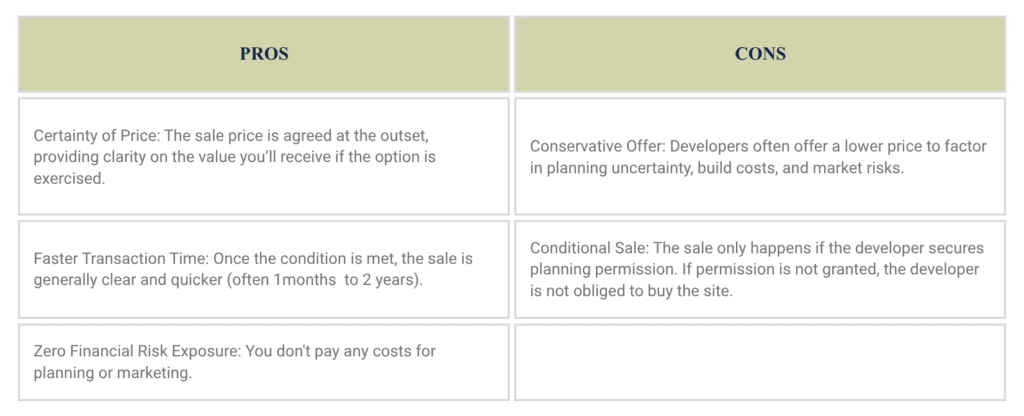
A property developer acquires the site, absorbs all upfront costs to manage the entire process of securing planning permission, builds the houses or commercial properties, and then sells them for a profit. They handle the whole job from start to finish.
The Developer’s Process of Acquiring a Site
When a developer buys your property, they take on the full financial responsibility for planning and development. Because they carry that risk, they structure their offers to protect their investment.
An Option Agreement gives the developer the right, but not the obligation, to buy the site at an agreed-upon price. This right is typically conditional on securing the necessary planning permission. This legal structure significantly mitigates the developer’s risk, because they are never obliged to purchase the land, they only exercise the option once the necessary conditions (like successful planning) are met. They still, however, cover all the application costs, whether the planning succeeds or fails.
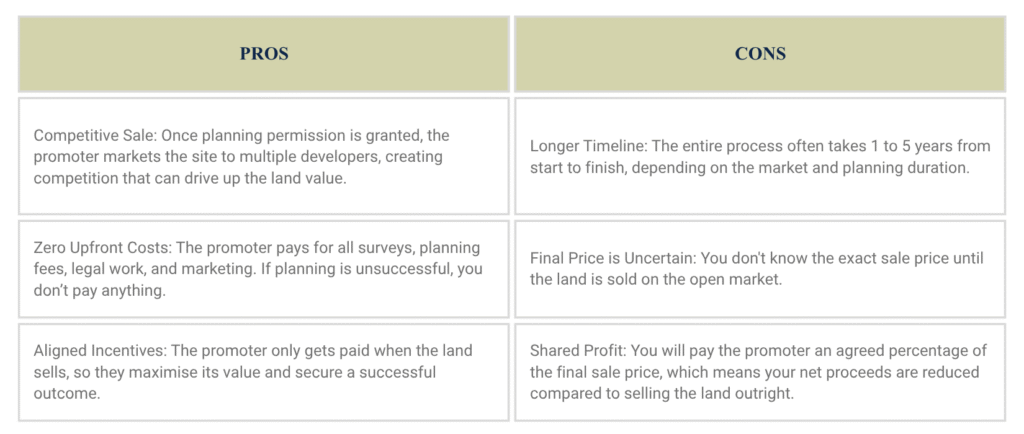
A land promoter is a specialist firm that works on your behalf. Their role is to increase your land’s value by securing planning permission and marketing it to developers. You retain ownership throughout the process.
Once planning is obtained, the promoter markets the site to multiple developers in a competitive process, aiming to secure the best price available in the market.
The Land Promoter Process
The crucial difference here is that the promoter does not buy your land; you retain full ownership throughout the entire process. This arrangement is set up through a land promotion agreement.
Let’s look at a scenario to see how these strategies play out in practice:
A site was originally advertised for £1.2M by a land promoter. It spent many months on the market without finding a buyer at that price. Eventually, the site changed hands at a much lower figure.
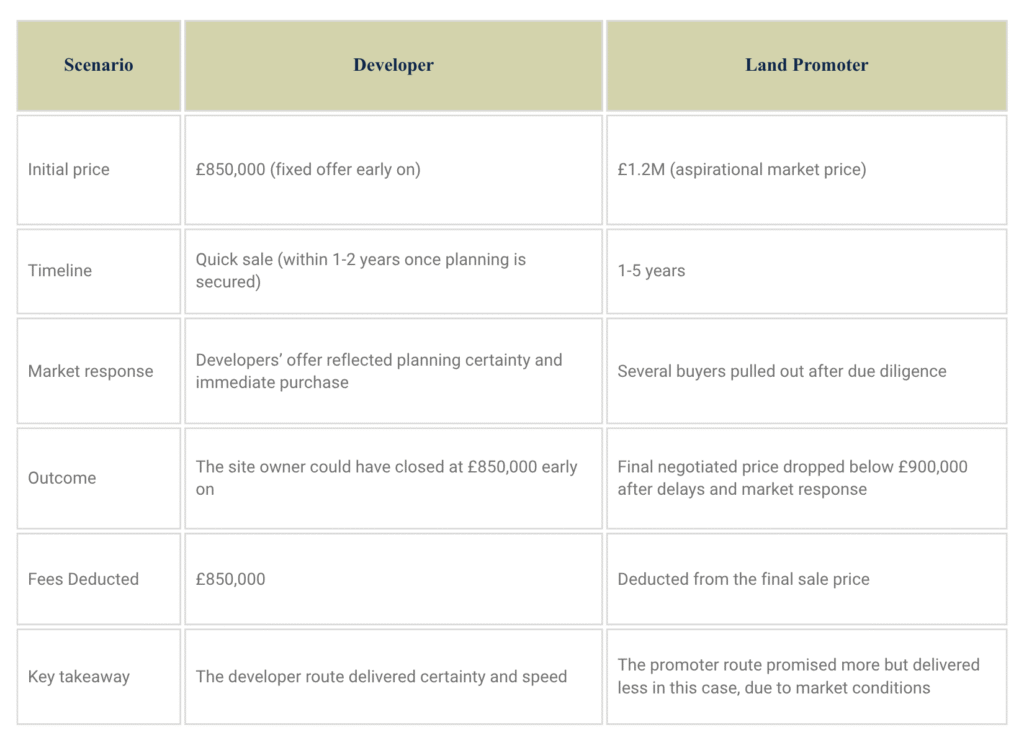
Risk vs. Reward Summary
The right choice depends completely on your financial needs, your personal patience, and what level of certainty you require. Remember, the site owner faces zero financial risk exposure in either scenario; it’s only a question of time and potential return.
Choose the Developer If…
Choose the Land Promoter If…
Ultimately, the decision between selling to a developer or working with a land promoter hinges on striking a balance between speed, certainty, and potential return. Selling directly to a developer offers a straightforward and predictable route to market. You get a fixed price, a faster transaction, and no financial exposure to planning or marketing costs. This path suits those who want clarity from the outset and prefer to avoid the ups and downs of the open market.
On the other hand, partnering with a land promoter is a strategy built on patience and the pursuit of maximum value. By allowing the promoter to secure planning and attract competitive offers, you may achieve a higher sale price, though the timeline is longer and the outcome less certain. Both paths have clear strengths and trade-offs, and the right decision ultimately depends on your personal priorities and financial goals.
Unlock the value of your asset without taking on the financial risk. We cover all planning costs and offer flexible agreement options—from clear-cut purchase to joint ventures—designed around your specific goals.
Hartley Residential builds quality homes with a focus on design, comfort, and lasting value.


Quick Links
SPEAK TO US
ACTIVE HOURS
Monday – Friday 8:00 am to 5:00 pm
© Hartley Residential 2025. All rights reserved!